

Published On: August 17, 2018

3 Considerations When Capitalizing Your Business

Whether you want to launch a business or grow it, you may have the need to capitalize it. In short, this means financing it. And in doing so, there are things to consider as you open your doors, or take your business to the next level.

First, what does capitalizing do?

Technically speaking, capitalization refers to the cost of equipment that is written off as depreciation over time. It also refers to the converting of retained earnings into capital or of an operating lease into a capital lease. In general terms, it means the investment you make in your business, generating money to make the business happen. It may be called funding, backing, capital investment, or owner’s stake.

When you capitalize a business, you’re able to combine funding with your operating cash flow to pay for assets such as equipment, vehicles and real estate, or plan for growth through purchasing inventory, hiring employees, or financing receivables. It also allows your business to reserve funds for emergencies.

There are many ways to capitalize a business. Two of the more popular ones are equity or debit funding, or a combination of both.

Equity funding

As in other financial situations, equity basically means ownership. Capitalization through equity funding involves the investment of the owners, which can take on many forms. Investors can own stock or shares in your business, or partners can be issued partnership interests.

Equity funding can be beneficial in that there is no debt involved and therefore no credit history is required. The money comes outright from the “owners,” so in most cases there’s no need to pay back investors.

The downside is that while investors provide essential funding, they also gain important rights. You may lose some control over your business as every investor will be able to have a say in how funds are spent. If your business is your baby, you may not want to relinquish that kind of power. In addition, in most cases, investors also recoup their share of the profits, which may end up being more than the cost of a loan.


Debt funding

Another way to capitalize a business is through debt funding. This allows you to take immediate action to open your doors or grow your business by taking out a loan.

There are many ways to do this, whether direct financing through a bank or more complicated arrangements such as with angel investors or venture capitalists. Debt funding is beneficial in that you don’t have to give up any ownership interests. The business remains in your control. At the same time, you make regular payments that can help you build business credit. And going forward, the interest you pay on the loan can be written off as a business expense.

The downside of debt financing is that you’ll need enough cash flow to make regular loan payments. Not making timely payments can hurt your credit rating. Taking out a loan can also can increase your debt-to-equity ratio, which can paint the business in a negative light. Another disadvantage is the debt is often tied to collateral, which may be the business itself or the owner’s personal assets.


Capitalizing interest

Something to consider when capitalizing your business is the opportunity to capitalize interest. This refers to the interest you pay on loans to finance your long-term assets. When you capitalize interest, you add the cost of the interest to the book value of the long-term asset.

In that way it’s seen as a depreciation expense rather than an interest expense. This can reduce the business’s profit “on the books,” while not reducing its cash flow.

The downside of this option is that you cannot realize the tax benefits in the same year the loan is taken out. The interest expense can be recognized as a depreciation expense in a later period.

Capitalizing your business is something every owner must consider whether they’re just starting out or they’re ready to grow, acquire, and move into new markets. Many times, the capital comes from a variety of places – owner’s savings, personal investors, interested partners, or long-term business loans. However, you choose to obtain funding, there are options that can help you succeed.

Authored By Diedre Barret – Senior Vice President of Sales and Marketing for Guaranty Bank

Published On: July 17, 2018

5 Ways To Market Your Business Using Social Media

Facebook, Twitter, Instagram. Chances are you’ve heard of all these and countless more in your personal life, you may have your favorites, or you may ignore them all together. But in business, social media is essential. Whether it’s to create brand awareness or generate leads, social media connects your business to the world and can be an essential component of your overall marketing plan.

FIVE TIPS to help ensure you’re getting the most of your social media strategy:

Choose the right platforms for your business

Did you know that are more than 60 social networking sites? Social media platforms vary in features, functionality, and target audience, so choosing where to invest resources depends on your business and who you’re trying to reach.

For B2B businesses, it may be helpful to focus on Facebook, Twitter and LinkedIn. For B2C companies, and especially those seeking younger audiences, adding Snapchat, Instagram and Pinterest may be a sound decision.

To get started, focus on setting up and maintaining three or four sites. On each one, make sure you’re listing up-to-date, consistent information about your business and that you’re optimizing your profile for each site.

For example, on Facebook you can add a “Shop Now” call-to-action on your cover. For each account, make sure your brand is represented with your logo, colors, taglines and smart copy. Be sure to link to your social media accounts from your website.

Think content, content, content

Thinking you have nothing important to say stalls you from posting anything! In reality, content ideas are all around you. Remember that YOU know your business, but your customers do not. Let them know about new products or services. Post a behind-the-scenes look at your office or facility. Weigh in on a topic that’s happening in your industry, and invite comments from others. Depending on the platform, consider adding videos or customer polls, which can be entertaining and engaging. You can always highlight information from your website – this will maximize your web content and drive traffic!

Important to keep in mind also: IMAGERY. Posts with pictures are more likely to get likes or clicks. Social Media Examiner reports that 74% of social media marketers use visual assets in their social media marketing. 

 Post regularly

Make social media part of your daily and weekly tasks. Depending on your audience and platform, you’ll want to post, share, like, follow, or retweet several times a day or a few times a week. To make things more efficient, create a social media calendar to generate and coordinate your posts, and schedule bulk-posts on a free software platform like Hootsuite.

Your business may lend itself to regular topics and themes. For example, if you’re an accountant, you may want to do weekly posts for “Tax Tip Tuesdays.” This lets your audience know to watch for your posts every week, and it gives you an opportunity to showcase your expertise, which can generate leads.

Pay to Play

The ever-changing algorithms used by social media platforms can make it challenging to ensure that your customers and potential customers actually SEE your content, which can be frustrating after you’ve spent time collecting and cultivating it. So placing social media ads can be effective in getting your message out there.

Most social media platforms offer advertising opportunities, and they vary based on how they look and how much you’re willing to spend. To get started, focus on which platform your customers are most likely following you.

Then, determine your business objectives: Do you want to raise awareness, increase engagement, boost traffic to your website or generate revenue? Depending on your goals, the platform can guide you through options in graphics, timelines and audience.

Interact

Finally, remember that social media is social. Just like your business often grows through word of mouth as well as networking, your business can grow by interacting, commenting, sharing, and participating in social media. This is called ENGAGEMENT and we all want it!

When you post, invite others to comment, and do not be shy about posting on other business’s pages. Posting and commenting keeps you in the conversation and top of mind to viewers. Every time they see your profile picture your brand is reinforced. Stay in the game!

In summary, social media can boost your marketing efforts and add visibility and credibility to your brand. If you’re just starting out, take the time to set up your social media accounts. Assess new and existing accounts and make sure they’re optimized for every opportunity.

Authored By Diedre Barret – Senior Vice President of Sales and Marketing for Guaranty Bank

Published On: June 20, 2018

It’s Time To Scale – Women In Business

Authored By Diedre Barret – Senior Vice President of Sales and Marketing for Guaranty Bank

When you started your business, maybe it was a side hustle. Or maybe you set out to fully establish your business from day one, but the ramp up time was slow and you needed another stable job to supplement your income. At first, you probably spent a couple of hours per week on the business and made a little bit of money to cover the costs. As time went on, you started to see that there was a way to make this a full-time job.

Now it is time to scale the business.

Maybe you need capital to increase production, employees to handle demand, marketing to reach the next level or capital to fulfill a big order.

Here are 6 topics to consider as you scale your business:

Ask your bank for additional services:

Your bank can be an invaluable resource for add-on services that help to make day-to-day business a bit easier. Services such as remote deposit, payroll services, company credit cards, integration with accounting software and many other services are offered by your bank at little to no cost. Each of these services can help you to save time or money to allow you focus on growing the business.

Look for the free (or low cost) money:

When people think of grants, they typically associate them with non-profits or student businesses.  There are thousands of grants available to for-profit businesses each year. But, where do you find them?  A great place to start is the local bookstore or library. There are books published each year that list all available grants and give a blueprint for how to write your application. You can also look to government entities, such as the U.S. Small Business Administration.

Finally, you should seek information from your local government office on grants available in the area. You can also check with your bank to see if there are any funding options at low cost through government backed programs.

Use social media to tell your story:

Many people use social media to pitch their product, but few businesses do it with any strategy. The key to social media is consistency and supplying content that people will read. Here is a simple road map to follow when building a marketing plan around social media.

  • Run a like/follow campaign to build your presence. Give away your product as a way to reach more people.
  • Humanize your business. Tell stories each week about your employees; or your struggles; or your successes. People are interested in you just as much as the business.
  • Get involved in the community and share your stories with your followers.
  • Be consistent. Try to post once per week (or more) and use themes to help organize posts. Themes can include ideas like Product Mondays, Employee Wednesdays and Community Fridays.

Know your numbers:

Knowing your numbers can make your business grow much faster. If you were asked your sales from last month, would you know the answer? Let’s say you do know the answer and it is $50,000. From that $50,000, how much did the company make after all expenses were paid? These are fairly basic questions that a business owner should know each and every month. If you don’t know the numbers, how do you where to focus for growth?

Here are a few tips when looking at your numbers on a monthly basis:

  1. Quantify success and failure.
  2. Know exactly how much it costs to produce your product.
  3. Create value in order to get premium pricing and profitability.
  4. Know what it costs to run your business each month (overhead).
  5. Be aware of problems before they arise by looking at trends in costs and revenues.

Utilize SAS solutions to fill a void:  

SAS (Software as a Service) and can be used to perform many different jobs to improve the efficiency of your business. Many SAS solutions are free for trial or basic versions and then have a monthly charge for a subscription to the service. According to idonethis.com, the average startup uses 17 SAS-based solutions on a monthly basis. As technology becomes faster and more intuitive, look to SAS as a way to optimize your business.

The #1 reason businesses fail:

The number 1 reason a business fails is not enough revenue has been generated to sustain the business. Another way to say this: you need to get out and SELL. Sales are the life blood of the business and in order to scale, you need the revenue and demand to support the increase in production. Think of alternative channels to sell your product such as strategic partnerships, co-ops, online, local, wholesale or white-label. Open up more sales channels and the revenue will follow.

Published On: May 25, 2018

Finding Your Path – Women In Business

If you are like most in the world, you found yourself graduating from high school or college without the faintest idea of what you wanted to do for a career.  At the time, you found work that was available and perhaps settled into that particular job or industry as life began to happen.  As the years went by, you developed new passions and found inspiration in places that a younger version of you did not know existed.  Now, you are versed in the ways of the world and the passion for your hobby has become so powerful that thoughts of tuning it into a full-time job creep into your mind.  Here are a few examples of hobbies that make great businesses:

Health and Beauty

The health and beauty sector is booming.  In 2017, the industry reached over $17 Billion in sales, which was a 6% increase over 2016.  Additionally, over 82% of women surveyed believe that social media is the primary influencer of health and beauty trends.  Due to these statistics, there has been a rapidly increasing number of private distributors that have emerged to sell your favorite product direct from the manufacturer.  The days of the Avon Lady are back!  The keys to success as an entrepreneur in this space are to be passionate about the product and make it your full-time commitment.  In this industry, if you give a 10% effort, you will get a 10% result.

Fitness/Wellness

Fitness and wellness continue to be a rapidly growing market.  Whether it is a large-scale gym or small scale personal training center, new businesses are born every week.  Many people who get into these businesses do it in steps.  Perhaps, you go to a spin class on a daily basis and then after a year, the instructor asks if you would be interested in leading the class.  Since spin has become your passion, you oblige and collect a small fee or discount for the service you provide.  You then see there is an opportunity to take your passion to the next level and decide to invest in your own studio.  The key to success in this industry is that you must be hands on and ready to do the work to make the business thrive.

Design

The rise of Pinterest has given birth to a whole new segment of DIY designers.  Perhaps you have taken your creative passion to the internet and have received requests for more of your creations.  Whether your passion is creative design or tangible design, businesses are calling for freelance designers on a daily basis.  Sites like elance, sortfolio, upwork and freelancer are excellent places to display your work and find contract work.  Based on your availability, this can become a full -time job without the constraints of an office setting.

Childcare/Education

Statistics say that there is a major shortage of child care professionals in the workforce today.  If you have created a passion around early child development, there are many ways to turn this passion into a business.  Whether you decide to get into daycare, tutoring, mentoring, para-education or teaching, you have the ability to start a business in this segment.  The key to success in this segment is to ensure that you have all of the necessary legal and paperwork complete prior to starting your endeavor.  Once these are complete, find the segment that is of interest to you and start to learn the ropes with an established business or mentor.

Women in Business series authored By Diedre Barret – Senior Vice President of Sales and Marketing for Guaranty Bank.

Published On: December 26, 2017

End Of Year Financial Checklist

As the end of the year approaches, it is time to compile a checklist of items that need to be in order before December 31st.  While it might seem easier to push a few things off until next year, or bundle them with the New Year’s Resolutions, organization of your financial life can give you a head start in 2018.  Here are a few items to add to your end of the year checklist:

Check beneficiaries – It is a best practice to check your beneficiaries on an annual basis.  Beneficiaries are people who have been designated to receive a benefit from a policy or account in the case of death.  Possible reasons to change a beneficiary could include their death, marriage, divorce, name change or minor becoming an adult.  Making this part of the year end checklist will make it easy to remember.

Empty flexible spending accounts – Flexible spending accounts are usually tied to health insurance.  Most accounts expire at the end of the calendar year, although some could roll over or have a grace period.  Check with your insurance provider or employer for exact details for the plan.  If the account does expire at the end of the year, spend the remaining allotment on approved medical expenditures.

Max out retirement contributions – You are allowed to contribute a certain amount of money into a 401K or Individual Retirement Account (IRA) during a calendar year.   The contribution could be used as a tax deduction in the case of an IRA or pre-tax income in the case of a 401k.

Donate to charity – Charitable donations are an excellent way to earn additional tax advantages, while contributing to your local community or favorite charity.  If your donations are in tangible items, as opposed to monetary, ask for a receipt from the charity for evidence of the donation.  It is also a good idea to take a picture and keep it with your records.

Set up a meeting with your personal banker – It is a good idea to set up a meeting with your personal banker on an annual basis.  Bank products change on a regular basis, as do interest rates and it is possible to get a better product than you currently use.

Start thinking about next year – Here are a few questions to consider:

If you answer “yes” to any of these questions, it is a good idea to discuss with a banker or financial planner.

If you have any questions regarding end of the year planning, you can contact us by clicking here or call us at 662-247-1454.

Published On: December 12, 2017

E Statements – Safe and Secure

An e statement, or electronic statement, is an electronic version of the paper statement that is customarily sent via mail.  The statement usually comes once per month and has a listing of each transaction that occurred within the account.  The primary difference, other than delivery, is that the electronic statement can be accessed at any point in time and aggregate transactions.  Here are a few benefits of using an E-Statement:

Information is at your fingertips – E statements add a level of convenience to your banking relationship that lets you control your finances on your schedule.

  • Receive an e mail from Guaranty Bank when your statement is ready.
  • View our statements 24 hours a day, 365 days a year from anywhere with internet access.
  • Download and save your statements for print or e mail. You are able to produce your statements for third parties such as an accountant or attorney.
  • Merge your statement into software such as Quicken or other Personal Financial Management software.

Safer than paper statements –  E statements cannot be taken from your mailbox, delivered to the wrong address, misplaced in a filing system, or taken from your trash.  When you log into the E-Statement portal on GBTonline.com, your connection is encrypted and secure against any unwanted threats.

Good for the environment – When you use E Statements, you are doing your part to extend the life of our precious natural resources.  Studies show that a paperless office uses only 30% of their paper based counterparts.  United states office consumption is upwards of 12.1 trillion tons of paper per year.  Every little bit helps!

In order to sign up for E-Statements from Guaranty Bank, do the following:

  1. Sign into your Online Banking Account and complete the following steps:
    1. Hover over the “Administration” tab
    2. Click “Change Statement Deliver Method” link
    3. Change your Statement Delivery method from paper to “online”.
  2. Call your local branch to get signed up.

If you have questions about E-Statements click here or call us at 662-247-1454.

Published On: October 11, 2017

Best Practices – Mobile Banking

Mobile banking usage has tripled since 2009 to over 111 million users nationally (source: Statista).  At the current growth rate, mobile banking could replace internet banking by total users within the next 7 years.  Although mobile banking offers you the freedom to monitor your account, communicate with the bank and a host of other features, the convenience opens the opportunity for fraudulent activity.  Although mobile banking is one of the safest digital tools, best practices must be used to ensure safety.

Password Protect Your Mobile Device – Keeping passwords on your device is the first line of defense against fraudulent activity.  Lock the device when it is not in use and require a password to access.  Do not use sequential passwords (1234) or passwords that have your information (address, your name, street).  Consider using a pattern, fingerprint, or other authentication for access to your device.  If you use Mobile Banking with Guaranty Bank, you have the ability to use a fingerprint sign on (if your phone is capable).  Also, when using mobile banking, do not use public WIFI, but rather a secure access point that blocks others you do not know.

Do not expose sign on passwords – When logging into mobile banking, keep the password information masked so it is not sitting within the log in box.  Also, always log out after use and do not use autofill for the password when logging in.  These settings will help reduce risk if your device were ever in someone else’s hands.

Update your phone –  Updates to your phone usually include bug fixes and patches.  A patch is a piece of code that has been built specifically after a vulnerability has been detected.  Do not delay updating a device when something has been released.

Delete bank text messages – Delete text messages from the bank after you have read them.  Although there is no information within the text, it is still a best practice to not leave them on your device.  As a reminder, your bank will never ask you for your account number, PIN, or any other personal information via text message.

If you lose your phone – If your phone is lost or you change your number, contact the bank immediately and have your mobile account put on hold.  You will need to download the service again with your new device and go through the registration process.

Do not modify your device – If you have modified your device in any way from its original performance specifications, it is not wise to use mobile banking on the device.  This includes phones or tablets that have been altered to improve performance, download third party software, change root files or enabling features that void warranties.

If you would like more information on mobile banking click here or call your local branch.

Published On: September 27, 2017

Guaranty Bank Provides Financial Education

During the 2016 – 2017 school year, Guaranty Bank partnered with EverFI to bring Financial Education to local area schools.  The program is designed to provide digital education resources to schools, with no cost to the school or school district.  Financial education courses include everything from introductory topics such as saving and budgeting, to advanced topics like insurance, taxes, and investing.  At the end of the program, students will have a more thorough understanding of financial concepts and are better prepared to make decisions. These skills will help them reach their financial goals in the future.

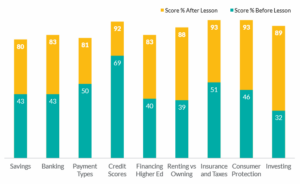
Guaranty Bank, along with EverFI, were able to provide instruction for 296 students in 3 county schools.  This added up to over 1,800 hours of learning.  Scored topics included financial literacy, understanding money, and money management.  The results for the participating students were astounding!

Financial Literacy

The course on financial literacy included lessons on banking, savings, payments, credit scores, student loans, renting vs. owning, insurance and taxes, consumer protection and investing.  The students increased their pre-test scores by an average of 89% upon completion of the course.  The greatest gain was seen in the renting vs. owning segment.


Understanding Money

The key question in the understanding money course is, “can you help your friend from outer space understand the difference between needs and wants?”  In this course, the students completed lessons on the following topics:  responsible money choices, income and careers, making plans with money, credit and borrowing, insurance and safety, savings and investing.  Students showed the highest gains in savings and investing.


Money Management

Research shows that feelings of self-efficacy, or confidence in one’s ability, are an important outcome in financial education.  This confidence in financial capability will carry all the way into adulthood.  After taking the course on money management, the students are more confident and better prepared to make financial decisions.

If you would like more information on Guaranty Bank and our commitment to financial education, please click here.

Graduating Class From Guaranty Bank Financial Education Class
Financial Education Graduates – Guaranty Bank
Community Development Officer - Guaranty Bank
Clifton Williams – Guaranty Bank
Graduation Ceremony - Guaranty Bank Financial Education Class
Graduation Ceremony – Guaranty Bank
Published On: September 12, 2017

Information On The Equifax Data Breach

If you have established credit, there is a high probability that you were affected by the data breach at Equifax.  According to Equifax, which is one of the country’s three credit reporting bureaus, the breach lasted from mid-May through July and affected 143 million consumers.  Although some of the records were from the UK and Canada, there is still a good chance that you were affected.  The hackers accessed people’s names, Social Security numbers, birth dates, addresses and driver’s license numbers. They also stole credit card numbers for about 209,000 people and dispute documents with personal identifying information for about 182,000 people.

How can I find out if I was affected?

Equifax has created a portal on their website to help consumers find out if their records were compromised.  You can get to the website by clicking here.   Once you complete the inquiry, the site will prompt you to register for TrustedID.  Because Equifax was compromised, the safe best is to not put any unnecessary information back into their site.  You do not need to complete this action, regardless of the outcome of the test.  Guaranty Bank offers a monitoring system that will provide protection for the future through its Freedom Checking account.


What to do next?

Enroll in Fraud Alert– A fraud alert program is a system that is tied to your account that will notify you when suspicious activity occurs.  Whether it is your bank account, your credit card, or other banking account, a fraud alert or monitoring system should be activated.  Settings can be turned up or down based upon your own preferences.  Contact your financial institution for information.

Con artists may contact you – Historically, fraudsters will take advantage of customer awareness during a large breach and pose as your bank to gain information.  If someone does call you, ask to call them back at the number for your local branch.  You can also tell them you would be happy to sit down and talk to them face-to-face and ask to make an appointment.  Guaranty Bank will never ask you for your account number, your PIN, or your social security number on a phone call.  The only information Guaranty Bank will request is a valid e mail or phone number.

Check your credit reports – You can access your credit report through a number of different sources, including Guaranty Bank.  At Guaranty Bank, you can sign up for IDProtect, which will monitor your Equifax, Experian and TransUnion credit files daily, and automatically alert you if key changes occur.  It is also possible to obtain your credit report and look for suspicious activity.  If you suspect activity, contact your financial institution immediately.

Place a freeze on your credit – If you are not planning on making any major purchases within the next 6-12 months, it is a good idea to put a freeze on your credit.  This simply means that no one will be able to apply for new credit using your information (this includes you).  To activate the “freeze”, you will need to call each of the three credit reporting bureaus to make the request.

Monitor your bank accounts – Read your monthly statements or log into online banking to check recent activity on a fairly frequent basis. If you suspect fraudulent activity on your bank accounts, you may want to request all new credit and debit cards, as well as changing all of your passwords and PINs.

Watch your insurance – Because the hackers were able to obtain social security numbers as well as drivers license numbers, it is possible to steal your medical identity.  Signs of medical ID theft include:

  • a bill for medical services you didn’t receive
  • a call from a debt collector about a medical debt you don’t owe
  • medical collection notices on your credit report that you don’t recognize
  • a notice from your health plan saying you reached your benefit limit
  • a denial of insurance because your medical records show a condition you don’t have

If you have any questions please call your local branch or contact Guaranty Bank at 662-247-1452.

Published On: August 22, 2017

Prevent Wire Fraud

Wire fraud grew almost 400% in 2016, according to FBI statistics.  An increase in digital payments and wire transfers have given fraudsters new ways to compromise your accounts.  When you or your business are conducting wire transfers, consider the following topics to avoid becoming a victim of wire fraud:

How Did You Receive Payment Instructions?  For typical transactions, payment instructions will be specific.  For instance, the receiving party will provide all of the required information on an official form or document.  Phone numbers, e-mail addresses and websites can be reproduced by fraudsters, but public search can be used to verify. Here are a few signs to look for when receiving payment instructions:

  • Does the company have a website?
  • Does their digital presence seem to match what they sell?
  • When the company is “Googled” do they show as a scam?
  • Can you call a publicly available number to confirm, such as the bank customer line?

Do You Know The Recipient Of The Payment?  Many fraudulent transactions are executed by a person or small group of people who try to gain access to your information by posing as a potential customer.  Even if they are known to you, call and confirm the name and email address of the person on the other end.  If they are unknown to you, look for these common themes used by fraudsters:

  • They are from a foreign country or out of your typical market.
  • They are representing either the United States Government or a foreign government.
  • They will not meet with you in person.
  • All of your interaction has been over e-mail.

Does The Transaction Seem Normal?  You have executed thousands of legitimate transactions over the course of your professional career.  It is a rare occasion where one of those transactions is done differently than all of the others.   Here are a few transaction types that might raise a red flag:

  • You have won something for which you did not register.
  • You are asked to send money as part of a job application.
  • You are asked to pay for a good or service by paying a third unrelated party.
  • You are asked to receive payment (in the case of selling a car) via a P2P site.
  • You are asked to provide information for a “refund.”
  • The offer seems “too good to be true.”

Execute Best Practices For IT Security – The first line of defense against fraud for any business is to execute best practices when it comes to IT security.  Adhering to simple rules can drastically reduce your risk of fraud.  Here are a few best practices that you should consider:

  • Change passwords every 60 days.
  • Use complex passwords, include letters, numbers and symbols with no meaning.
  • Check credit card statements monthly.
  • Keep card information secure.
  • Keep firewalls and malware defense up to date.

If you have any questions about wire fraud, please call your 662-247-1454 or click here for more information.

Link Disclaimer

The link you are attempting to follow is outside our domain. We do not provide, and are not responsible for, the product, service, or overall website content available at any third-party website that is linked through this browser.

If you agree to these terms select 'Continue' below. If you disagree please click 'Cancel' and this box will close.

continue