
Published On: December 8, 2020

Succession Planning

Succession planning is becoming a bit more fluid as business owners are more likely to stay in the workforce longer than past generations.  Long past are the days when retirement was imminent at age 62 or age 65.  Just because the “right time” is not set in stone, it is still critical that the business owner has a succession plan that is well thought out and ensures that the business will thrive.  Here are a few tips to consider while thinking about a succession plan:

Start Early – A common problem in succession planning is that the process does not start until the plan is needed.  A good plan will have framework 8-10 years prior to retirement.  This will allow for quick action to be taken in the case of an emergency, such as an illness, and also allow for the plan to change with the business.  The pressure of succession planning can be intense, early planning will relieve the pressure and let the business owner focus a majority of their effort on running the business.

Find Your Experts – In every business there are employees who excel at specific skills or tasks.  As part of a succession plan, find those employees and help them develop that particular skill to an expert level.  If there are multiple experts, part of the plan can be for them to pass their expertise on to their team to ensure that the business can sustain long after the principles are gone.  Their experience as part of the team is very valuable, do not waste it.  Instead nurture it and use it as part of the overall plan.

Be Honest With Yourself – There are many questions a business owner must answer as they look to walk away.  One question is, “why do you think it is time to walk away?”  Do you want to spend more time at home?  Do you want to travel?  Do you think it is just time to pass the business on?  No matter the reason, the lack of a very clear answer can make the planning and transition difficult for both the business owner and the team through the planning process.

Understand That Planning Can Be Difficult – Part of succession planning is having some time to think about what is best for you as the business owner.  Is it best to keep the business in the family?  Is it best to leave it to the employees?  Will the business thrive under new leadership?  Understand and accept that keeping the business in the family might be a difficult decision.  Perhaps children are still in school, or do not have the experience needed, or family has never been involved in the day to day.  Ultimately, the business owner needs to feel good about the plan, regardless of what others may think.  The planning process could include mentorship for family, or an increased level of involvement.  Any transition is difficult, be ready to receive criticism for the decisions, but with proper planning the business owner can walk away feeling they have done what is best for everyone involved.

Walk Away – When it is time to execute the plan, be ready to walk away from the business.  Maybe the plan calls for limited involvement through a transition period, or no involvement at all.  No matter the case, it is up to the business owner to live up to their part of the agreement.  If the plan calls for limited involvement, put an actual number of hours per week so there is clarity for both sides.  When it is time to walk away from the business, walk away and watch your legacy grow.

Published On: December 3, 2020

Gift Card Drive

Guaranty Bank is proud to announce its 10th annual Holiday Toy Drive.  The drive will run now through December 18.  As part of our drive this year, we want to celebrate how far we have come since its inception in 2010!

Our toy drive started 10 years ago when Guaranty Bank partnered with a local radio station that was hosting a toy drive for St. Jude Children’s Hospital.  We had an amazing outpouring of gifts in 2010 and we were proud to be a part of such a wonderful program.  Even though we only had 9 branches at the time, we collected enough toys to fill 4 SUVs.  Over the next couple of years, we expanded our branch network which allowed us to partner with Blair Baston Hospital and include them in our annual toy drive, also.  Our toy drive has expanded so much that we now include multiple people from the Bank and the community to help us gather and transport the toys.  This program has become a favorite for employees and customers, and we look forward to its success in 2020.

This year we are collecting gift cards in lieu of toys. Because there are so many children in need, we need you to help us make 2020 the best turn-out yet!  The greater the number of gift cards collected, the more children who will have an opportunity to receive one.  If you decide to purchase a $25 gift card, consider buying five $5 cards instead to meet the needs within the hospitals.

Examples of gift cards that were suggested by our partners:

    • iTunes
    • Google Play
    • Xbox
    • Kroger
    • Hobby Lobby
    • Michael’s
    • McDonald’s
    • VISA Gift Cards – Can be purchased at Guaranty Bank

Gift Cards can be dropped off at any Guaranty Bank location between now and December 18th.  Our Goal is to collect 1,000 gift cards between our 22 locations.  That is roughly 3 cards per location per day.

Families at St. Jude Children’s Research Hospital and Blair Batson rely on the generous donations from donors like you to make their hospital stay at Christmas time a little easier. Your donation of a gift card or gift cards will become part of a Christmas experience for these families.

Although this is not the kind of year we expected, we can still make it festive and jolly for those in need. Thank you for partnering with Guaranty Bank, St. Jude, and Blair Batson Hospital by brightening the spirit of a child and donating a gift card during this year’s Holiday.

Published On: November 24, 2020

What is the Best Way to Get Small Business Funding?

You have a great idea. You have a vision. Now you just need the money to get it off the ground. This is where small business funding can give you the boost you need. There are many loan options available that can help you start your business or take your business to the next level.

Evaluate your need
The first step to getting small business funding is figuring out why you need money and how much you need. A well-thought-out business plan will be a good starting point in determining the cost of equipment, services, staffing, and marketing and sales. From there, loans are available based on how much you need and why. Is it to manage day-to-day expenses before you start to draw a profit? Or is funding needed to grow your business to the next level? Having a firm idea can help you present a solid case to a lender and also prevent you from borrowing too much – or too little – in order to meet your goals. It will also give you a good idea of your overall financial picture to make sure you do not get in over your head.

Funding options
From there, there are a variety of paths to take to get funding. Many people first turn to their own assets – savings accounts, certificates of deposits, money market accounts, or even their homes. They also might draw on their personal credit cards or lines of credit. They might also seek support from friends and family, either in the form of a loan or an opportunity to be front-line investors.

One funding source that is gaining in popularity is crowdfunding. Crowdfunding is an online vehicle to raise money from potential investors. It involves setting up a crowdfunding campaign by creating a profile for your business, project or service. Then you set a funding a goal and publish your request. People who are intrigued by your idea can donate to your cause in exchange for some level of ownership of your business assets. Crowdfunding provides an opportunity to not only attract investors but market your business at the same time. Another benefit is that because the funds are actual investments in your business you do not have pay anyone back or worry about interest rates.

The next place to look is at Guaranty Bank. While a bank loan often requires good credit and collateral, it may have loan programs and services your business can quality for, or it can be a resource to point you in the right direction. Banks are also often part of the local structure of a community, so they may have an interest in economic development and its impact on other businesses. Based on this, banks are a good starting point. And, as your business grows and you establish more of a relationship with the bank by accessing other business products like a business savings account, business checking account, or overall business services, you will improve your ability to get future funding from the bank if you need it down the road. This can include future business loans, a business credit card, or a business line of credit.

Credit unions are another source of small business funding. They can offer favorable rates and loans backed by the Small Business Association. Credit unions also are community-minded and have a cooperative structure that can make them conducive to lending to new enterprises. In fact, credit unions have increased their lending to small businesses by 60% since 2008. Online lenders who operate exclusively through the Internet are another option. These lenders may have lower credit criteria and may be optimal for people on a tight timetable funding.

One popular way to find small business funding is through the Small Business Administration or SBA. These loans are available through the SBA directly or through certain financial institutions and lenders. These loans often feature flexible terms and low interest rates, which are possible because the loans are guaranteed by the federal government. The SBA can guarantee up to 85% of loans of $150,000 or less and 75% of loans of more than $150,000.

SBA loans vary in rates and availability, and there are different loan terms based on how long you plan to use the money. For example, SBA loans for working capital or daily operations are seven years, for new equipment purchases, they are 10 years, and for real estate purchase, they are up to 25 years. To start the SBA loan process, the best approach is to contact the SBA, or to go through your bank or credit union. In doing the application, you will need a statement of personal history, personal financial statement, personal and business income tax returns for the previous three years, business certificate or license, a copy of your business lease and a loan application history.

There are also sources of actual free money out there if you have the time and patience to go through the processes. Government agencies provide a number of small business grants. These can be in the form of federal, state, regional funding for ideas that support economic growth and encourage entrepreneurship and innovation. Also, many corporations and large companies offer small business grants as part of their philanthropy and corporate responsibility programs.

Once your business is established and turning a profit, more money may still be needed. For businesses looking to reach the next level of growth or meet ambitious revenue goals, funding through angel investors or venture capital organizations may be an option. Angel investors are affluent people who either on their own or as a group provide capital to businesses, usually in exchange for some level of ownership of the business. Venture capitalists work in much the same way, but their goals for the transaction may be to build and grow your business so that it can be sold at a higher value.

When it comes to starting or growing your business, there is money out there to get you going. The trick is choosing the right source in the right option with the right borrowing terms. Contact Guaranty Bank today about small business funding programs and which one might be the best fit for you.

Published On: November 19, 2020

14 Things You May Not Know about the ATM

It is something people do all the time: Swing by the ATM. And most people probably don’t give the automated teller machine much thought. But there are some interesting facts about ATMs to keep in mind next time you grab some cash, and they may surprise you.

They date back over 50 years.  The first ATM opened on June 27, 1967, at a branch of Barclays bank in Enfield, north London. The first ATM in America opened on September 2, 1969, at Chemical Bank in Rockville Center, New York. This first ATM in the US could only dispense cash, but by 1971 they had evolved to also perform other functions, including providing account balances. Still, the early ATMs only let people withdraw $14 at a time.

There are millions of ATMs worldwide. ATMs soon went from only being in banks to being in malls, grocery stores, and gas stations. It’s reported there are over 3 million ATMs in the world, the equivalent of one unit for every 3,000 people.

 A blizzard started the trend. While ATMs were scattered around the United States for some time, their popularity didn’t take off until New York City was hit by a huge blizzard in 1978. The storm closed banks, and during its aftermath, ATM usage increased by 20%.

There are two basic types. There are two basic types of ATMs. With basic units you can withdraw cash and check account balances. Complex units accept deposits and also can be used to make line-of-credit payments, transfer funds, and report account information. Usually, to use the more complex units, users have to have an account with the bank that operates the machine. As time goes on, experts predict ATMs will get more sophisticated and operate like full-service banking terminals.

They can be owned by anyone. In many cases, ATMs are owned by banks and credit unions that use the convenience and location of their ATMs to attract customers. Businesses and individuals can own or lease ATMs as well. These ATMs are found in restaurants and convenience stores. Fees are typically charged to the user and go right to the business or person who owns or leases the ATM.

They are in demand. Sources say 75% of people expect convenience stores to have an ATM on site. The average withdrawal is $60. And the busiest day of the week for ATMs is Friday.

A machine by any name. In the US, automated teller machines are known as ATMs. In other parts of the world, they’re known as bank machines, money machines, cashpoint, or bancomats.

There’s a reason PINs are four digits. When the inventor of ATMs first came up with using a personal identification number to access the machines, he envisioned a six-digit code. He floated the idea past his wife, who said she couldn’t remember six digits. Based on this, the inventor reduced the number, and now four-digit PINs are the standard across ATMs and other technology.

They used to eat cards. In the past, it was common to insert your debit or credit card into the ATM and have the machine take the card – and not give it back! Now ATMs have been recalibrated. And now, with chip functionality, you must insert your card to start the transaction, but after that the card is swiftly ejected.

You can avoid fees. If you use your own bank’s ATMs, you generally don’t incur an extra fee for making transaction or withdrawing cash. But, it is common to be charged a fee for using ATMs that are not at your bank or at a competing bank. The average fee to withdraw cash at an out-of-network ATM is $4.66. Based on that hefty fee, if you have to use an ATM that’s not part of your bank, it’s best to withdraw a larger amount, so you don’t have to revisit the ATM frequently. Also, some banks may reimburse an ATM fee if there were no bank ATMs in the area.

You can save abroad. When using a foreign ATM, it is common to get cash at a better exchange rate than you can at currency exchange offices. And, it can be easier and safer to make frequent trips to an ATM when traveling abroad than to carry a lot cash or travelers’ checks. Keep in mind, however, that your bank may charge a transaction fee of a percent of the amount exchanged.

There’s gold in some ATMs. In some places, it’s possible to access gold from an ATM. The United Arab Emirates  was the first country to install a gold ATM. In America the first gold-dispensing ATM was installed in the Town Center Mall in Boca Raton, Florida.

All access, all locations. Nowadays ATMs seem to be everywhere. There are even two in Antarctica. There are drive-up ATMs and also ski-through ATMs. On top of Whistler Mountain in Canada, a ski-up ATM has holders for ski poles and gloves, and even heat lamps.

Cards not needed. The future of ATMs may be eATMs, which can be accessed via mobile phones, thus eliminating the need to carry a card to get cash. The ATM can be accessed via mobile wallets such as ApplePay or Android Pay. There’s also a whole new world of ATMs enabled with robotics and artificial intelligence.

ATMs are a modern convenience and powerful instruments. Even in a society where consumer preference for cash is declining, ATMs remain the primary and most reliable way to retrieve money all over the world. So, the next time you’re swinging by for cash, think of all there is to know about ATMs and remember your PIN – it’s only four digits!

Published On: November 18, 2020

Veteran Banker Ken Ibsen Joins Guaranty Bank

Picture of Ken Ibsen

HERNANDO – Hue Townsend, Chief Executive Officer of Guaranty Bank & Trust Company, today announced that Ken Ibsen has joined the bank and will serve as Vice President and Relationship Banker in Guaranty’s Hernando Office.

Ibsen brings 10 years of banking experience to his new position along with two plus years as a top aide to a growing hospitality company in the Mid-South. His diverse background in consumer and commercial lending combined with his experiences in running a small

business will serve him and the bank well in analyzing a dense customer base of small

businesses, health care professionals, and young entrepreneurs.

Ibsen is a graduate of the University of Mississippi and brings to his position a broad base of experience in Mississippi’s banking industry, having served as a credit analyst, commercial portfolio manager, and loan officer.

An involved community member, Ibsen has served on the Board of Trustees for Leadership Desoto and is an active member in the Krewe of Hernando, a non-profit organization of fathers and friends focused on community improvement.  Ibsen has also served in the Rotary Club of Hernando.  He and his wife, former Annabelle Reed of Oxford, have one son, Hollis and are active members of the Hernando United Methodist Church where he serves on the Finance Committee.

“My goal is to help Guaranty Bank grow in a sound manner as DeSoto County continues to blossom, Ibsen said. “Being from the Delta, I knew firsthand the customer experience Guaranty Bank offers, and I am proud to now embrace that experience for my customers’ benefit.”  Guaranty Bank’s Desoto County President Colie Sanford remarked “We are happy to welcome Ken to our bank family. His experience across the region and knowledge of our community will serve our customers well for many years to come.”

Press Contact:
Diedre Barret
Chief Retail Officer
Guaranty Bank & Trust Company
Office:  662.247.5134
dbarret@gbtonline.com


Published On: November 16, 2020

Keith Mitchell Joins Guaranty Bank

GRENADA – With nearly four decades of banking experience, veteran banker Keith Mitchell has joined Guaranty Bank & Trust Company according to Hue Townsend, Chief Executive Officer.  In his new role, Mitchell will serve as EVP Strategic Initiative in Grenada.     Mitchell joins Guaranty Bank after most recently serving as Market Executive and Commercial Banking Leader for the North Mississippi District for Regions Bank. During his tenure with Regions Financial Corporation, he served as Commercial and Industrial Relationship Manager and as a Community Banking Relationship Manager.

Mitchell is a graduate of Delta State University, where he earned his bachelor’s degree in Finance. Additionally, Mitchell has completed studies at the Graduate Banking School, conducted at Louisiana State University, the Vanderbilt School of Commercial Banking and the School of Commercial Banking held at the University of Oklahoma.

Mitchell has long been active in numerous civic, church, and economic development organizations. He is a Deacon at Grace Baptist Church and is Chairman of the Grenada County Economic Development District. He also serves on the Board of the Grenada Public Education Foundation, Inc. and as Treasurer of the Delta Council.

Mitchell is married to the former Beth Pinnix of Grenada and they have one son, Matt (Leah) and a granddaughter, Emma Grace.

“It’s not every day that we have the opportunity to add someone of Keith Mitchell’s ability and background,” Townsend said. “He is well-known throughout not only Grenada but all of the Delta region and north Mississippi. Business owners across the area will benefit from his expertise and relationship-based brand of banking.  I am pleased to welcome him to the Guaranty Bank family.”

Press Contact:
Diedre Barret
Chief Retail Officer
Guaranty Bank & Trust Company
Office:  662.247.5134
dbarret@gbtonline.com


Published On: October 13, 2020

3 Things to Know About Home Closing Costs

It is a term that is common when we talk about home loans, home equity lines or credit, and mortgage lenders: Home closing costs. Here, we look at what exactly these fees are and what you need to know to get the most value when you sign on the dotted line.

One: What exactly are closing costs?

Home closing costs are fees required at the time you sign for your loan, in addition to your down payment. They can include attorney fees, fees for a title search, title insurance, taxes, lender fees and sometimes homeowner’s insurance, but these fees can vary based on your lending institution and the state where you live or own property. Some fees are fixed like the recording fee or the transfer tax fee that is charged by the state or local government, but others like the lender fees can be negotiated.

What’s included in home closing costs?

Generally, closing costs fall under three main categories:

Lender fees involve all fees the lender takes on providing you the loan, such as loan origination fees, courier fees, home appraisal costs, administrative fees, credit checks, transfer fees, and underwriting fees. There can also be a charge for flood certification if required.

Points, if an option, can also be included under lender fees. If you are not strapped at closing with the money for closing fees and the down payment, asking your lender about the availability of discount points may be a good idea. With this option, you can pay for discount points – one point equals 1% of the price of the loan. Every point then can be used to lower the interest rate on the loan.

 Title fees can add a significant amount to the overall closing costs. Title fees can encompass the fees for a title search and title insurance. This can include title insurance to cover the lender, and optional owner’s insurance to protect you. This comes into play if you purchase a home, and down the road, someone else claims to own it or has not been paid for work on the home or owe taxes on the home. Title insurance insures your title and helps you avoid any future legal fees sorting things out.

Prepaid costs. Another component of closing costs are prepaid expenses that can vary by lender. Sometimes lenders collect two to six months’ worth of homeowner insurance premiums and property taxes to be held in a special escrow account. If you are able to put more than 20% of the loan amount down, you may be able to lower the amounts held in escrow.

Two: Who pays for closing costs?

The majority of closing costs, typically, are paid by the buyer. As a buyer, it is not likely that you can avoid paying closing costs entirely. Sometimes lenders offer incentives with deals on closing costs and points, but it is important to review those offers closely. If they sound too good to be true, they probably are.

Also, if you are borrowing through a homebuyer assistance program, there are loans available that have slightly higher rates, but cover the cost of some or all of your down payments as well as your closing costs. In this case, the buyer is still paying the closing costs but the fees are not due at signing.

Three: How can I save on closing costs?

There are some ways to save money at closing. Buyers can ask sellers to raise the purchase price of the home in exchange for a credit on the closing costs. This way the additional cost of closing is factored into the selling price of the home and thus into the overall mortgage. The buyer may spend more over time, but it can reduce the out-of-pocket costs at closing. As the buyer you can also request lender-paid closing costs. In this case, the lender may take on the costs, but in exchange they may charge a higher interest rate.

Another tactic that may lower the cost of closing is to negotiate the closing date. If you close at the end of the month, you may only be charged one or two days of prepaid interest. However, you may have to pay the full 30 days of interest if you close at the first of the month. Ask your lender what implications your closing date may have on the actual insurance fees due.

Other ways to save include:

  • Ask your lender about discounts and rebates. Some commercial banks will offer incentive to new borrower like $500 off a home purchase or loan origination fee.
  • See if you can cover title fees on your own. You may be able to get a better rate on title fees, title search and title insurance from a third-party vendor before your closing date.
  • Shop around. As you are researching loans, get a loan comparison sheet for every offer. As you compare interest rates and terms, take a close look at closing to see what is included and what can be negotiated.

Home closing costs are key components of every home loan. For people buying new mortgages, it can be challenging to both save for a down payment and save for closing costs at the same time, especially when closing costs fluctuate and you may not know exactly how much you need until close to closing time. For people who are refinancing or getting a second mortgage, closing costs can be a factor in determining if refinancing is worth it overall. It is important to weigh a new interest rate against how long you expect to be in your own to determine if the closing costs are a smart trade off.

At Guaranty Bank, we are always happy to answer any questions that you may have about buying a new home and closing costs. Contact one of our Mortgage Loan Officers to schedule an appointment!

Published On: October 1, 2020

Guaranty Bank’s Greenwood Office Earns Multiple Historic Restoration Awards

GREENWOOD – Hue Townsend, CEO of Guaranty Bank & Trust Company, today announced that the Bank’s historic Greenwood office has been honored with two distinguished awards for restoration to the facility, which was built in 1913 as the Wilson Banking Company. The Guaranty Bank facility is located at 122 Howard Street.

Townsend said the Bank’s building was recognized by the Mississippi Heritage Trust, earning its Heritage Award of Merit for Restoration.  Mississippi Main Street Association (MMSA) awarded Main Street Greenwood for Outstanding Historic Rehabilitation Project for Guaranty Bank’s restoration on the historic Wilson Bank building.

The Mississippi Heritage Trust released its list of award recipients on July 9th at Temple B’nai Israel in Natchez via Facebook Live. According to documents released by the Trust, the Guaranty Bank facility has “served as an anchor for downtown Greenwood architecture and had sat vacant for 10 years until Guaranty Bank decided to open a Greenwood Branch.”

Belinda Stewart Architects was hired to begin rehabilitation work, with an “overall goal of restoring the exterior and interior while sensitively inserting the modernized retail branding for Guaranty Bank, while implementing American Disability Act energy retrofits.” Among the work completed were restoration of the masonry façade, installation of large windows and stained-glass transoms, while the original mosaic tile floor, plastered beamed ceilings and glazed brick vault were exposed and “re-imagined for the bank’s space.” In addition, new glass offices were inserted to not touch the original walls and ceiling.

On August 19th, the MMSA celebrated a host of renovated buildings with a Virtual Annual Awards Program conducted at the Old Capitol Inn streaming live on Facebook.

MMSA Board President Steven Dick said the organization “was excited to celebrate the achievements of our Main Street communities. Our local leaders have worked tirelessly to provide economic opportunities, increase quality of life and preserve what makes our downtowns special.”  Brantley Snipes, Executive Director of Main Street Greenwood, with her passion to restore the Mississippi Delta, was thrilled that she and Guaranty Bank were recognized for their efforts.

“All of us at Guaranty Bank are honored to have received these awards,” said Robert Toomey, Branch President of Greenwood. “We are pleased to have enhanced downtown Greenwood, and we’re pleased to be able to come through these doors each morning in service to the community. It’s a great facility in which to work.”

Press Contact:
Diedre Barret
Chief Retail Officer
Guaranty Bank & Trust Company
Office:  662.247.5134
dbarret@gbtonline.com

Published On: September 22, 2020

Guaranty Bank Breaks Ground in Grenada

Guaranty Bank Breaks Ground in Grenada

GRENADA –

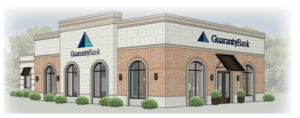
Construction is set to begin on the new build-out of Guaranty Bank & Trust Company’s location on Highway 8 in Grenada very soon, according to City President Brad Branscome. The Grenada Chamber of Commerce, Provine Enterprises, Double S Construction, and local city officials joined bank officers for a groundbreaking ceremony on Thursday afternoon, September 17, to signal the start of construction. According to Branscome, the expansion will encompass 3,700 square feet which will provide the latest in banking technology along with three drive-thrus featuring three Interactive Teller Machines (ITM). Construction is expected to be completed by April of 2021.

“With our tremendous growth in Grenada, this new build-out expresses our continued and future commitment to the community,” Branscome said. “We appreciate the support of our customers and look forward to many years of continued success in Grenada.”

Press Contact:
Diedre Barret
Chief Retail Officer
Guaranty Bank & Trust Company
Office:  662.247.5134
dbarret@gbtonline.com

Published On: September 15, 2020

What Does It Mean When Banks Say eBanking?

In the world of online banking and mobile banking, eBanking may sound relatively new. But the reality is that it has been around for decades, and you have probably been using it for some time. eBanking simply means electronic banking, and it is a form of banking in which the transfer of funds is done electronically versus with cash, checks or other paper.

eBanking – not online banking

eBanking transactions happen anytime funds are transferred between financial institutions or commercial institutions like stores, restaurants, and businesses – wherever payments are accepted. Electronic banking happens whenever you withdraw cash from an ATM or pay for something using your debit card. All these transactions rely on electronic interactions.

Recognizing that eBanking refers to all electronic transactions can help you better evaluate a bank’s services and convenience. There are other terms that can add confusion to the mix, including online bill pay, online banking, or mobile banking. Online bill pay is a form of eBanking in that it is a secure electronic service that allows you to pay bills without having to write checks and mail them. You can send individual payments electronically from your checking account, or you can arrange for payments to be regularly directed to a service provider, such as a credit card or utilities company. This eliminates the need to go to the post office. This transfer is set up to go automatically and allows you to make timely payments and avoid late fees or missed payments.

Online banking refers to the ability to perform account activity remotely via a website. By logging onto the bank’s online interface with an user name and password you can check account balances, transfer funds, apply for a credit card, order checks, or put a stop payment on a check. Online banking can happen from anywhere you have an Internet connection.

To add to the offerings, mobile banking can be a form of online banking in that you can access a website remotely on your smart phone. Mobile banking can also be done via banking mobile apps, which are available through Android or iPhone. A mobile app provides much of the functionality of online banking but in a format that is more conducive for phone access. Also with a mobile app, you can take photos of the front and back of checks using your phone’s camera and make mobile deposits.

The bottom line: While all these services do involve electronic banking, a bank’s use of eBanking does not mean it necessarily has the online convenience or mobile access to your accounts as the name suggests. Instead, eBanking laid the groundwork for these services. In some cases, it has paved the way for banks that are completely electronic. They have no storefront or physical location, and all account activity and all transactions are done entirely online.

How does eBanking work?

Most electronic banking is done with electronic funds transfer or EFT. This involves any fund transfers that are done from a phone, electronic terminal, computer, or magnetic tape. EBanking systems range in size. A larger system is the Federal Reserve Wire Network or Fed Wire, which is equipped to handle large transactions among multiple entities. Fed Wire, which links together the Federal Reserve, the US Treasury and other government agencies and institutions, can be used if you are transferring money internationally or there are large sums involved. A small system may be an ATM network, in which the actual ATM machine is connected to a financial institution via its own computer system.

The case for paper

eBanking has been around a long time, and new technology will only drive new advancements in user experience, transactions, and security. Yet, as much as electronic banking is here to stay, there are areas where paper is needed and desired. There are people who may not have access to high-speed internet at home. Also, people prefer the face-to-face, personal aspect of banking and having a relationship with an actual teller.

At the same time, by law, banks are required to provide paper statements as an available option, which many people still prefer when it comes to reviewing their accounts, checking balances and finding errors. Having a paper statement is also helpful for sharing account information with family members or financial planners. A stack of statements is often easier to go through and act on rather than figuring out passwords and logging on to bank websites. Also, with so much happening online these days, estatements can easily be overlooked. Having an actual document sometimes makes people more inclined to review them.

Despie eBanking being here to stay, customers still have plenty of options as to how they bank. The trick is to understand those options and choose the services that are important to you.

Link Disclaimer

The link you are attempting to follow is outside our domain. We do not provide, and are not responsible for, the product, service, or overall website content available at any third-party website that is linked through this browser.

If you agree to these terms select 'Continue' below. If you disagree please click 'Cancel' and this box will close.

continue